G2P: Gadget2 massive production with Planck cosmology
General description
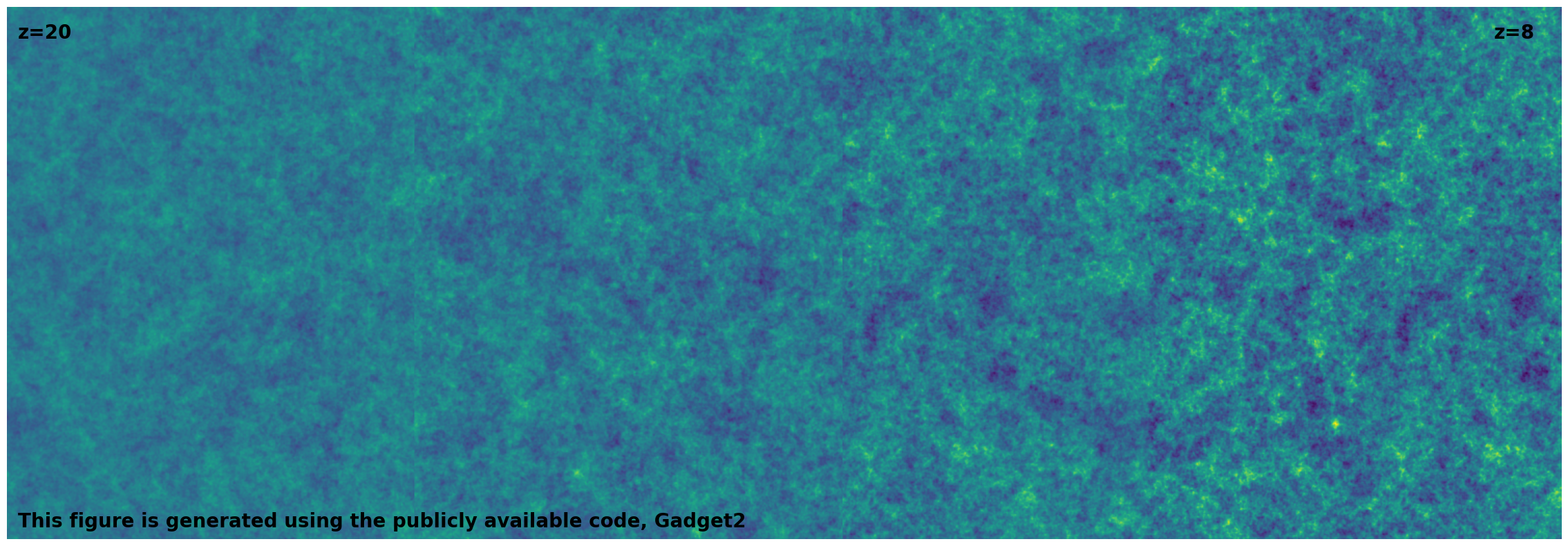
N-body simulations are one of the most useful tools to realize non-linear clustering structure of our universe at small scales for the purpose of testing cosmological models against large-scale structure survey data, for example, Dark Energy Spectroscopic Instrument (DESI).
In general, there are 4 steps in the pipeline to generate mock galaxy distribution. Let’s visit one by one.
- 1. Initial condition
- 2. N-body code
- 3. Halo finder
- 4. Galaxy painting
To prepare an initial distribution to be evolved using N-body code, we first need a linear power spectrum at high-redshift on which the initial particle distribution will be generated. We adopted Planck cosmology (2015, 2018) for the linear power spectrum at z=49 using CAMB.
Next step is to populate initial particle distribution based on the linear power spectrum using 2LPT code. This code generated a particle distribution which has the clustering feature of the given power spectrum with some non-linearity up to second order Largragian perturbation theory. Simply speaking, it generates two sets of random numbers, one for the amplitude of the clustering density fluctuation around the given power spectrum and the other for the phase of the density field in Fourier space. Depending on purpose, we sometimes discard the random numbers to fix the amplitude of the clustering, which preserves better the input clustering power at the scales of interest and the performance from two realizations with the opposite phases is comparable with the clustering feature averaged over 100 realizations of the random-amplitude mocks. Please check this page for the details.
Regarding the box size and mass resolution, we targeted wide-angle survey like DESI at large scales and adopted Lbox=1890Mpc/h and Nparticle=10243 where Lbox value is corresponding to the volume between 0.8 < z< 1.0 with the sky coverage of 14,000 deg2 where the DESI ELG galaxy’s number density is the highest. (ref. Table 2.3 of DESI paper) From these values for Lbox and Nparticle, we have about 1011M⊙/h for the mass resolution. Note that the initial redshift is determined considering the mean particle displacement. Please find the details in the tables below.
As for the accuracy of the simulation, we compared with smaller box with better mass resolutions and found that our dark matter only simulation shows more or less 1% accuracy up to kmax=0.2h/Mpc. Please find the plots below showing the convergence.
To evolve the initial condition to the targeting redshifts, we utilized the publicly available Gadget2. (Springel 2005b) It is a cosmological simulation code applicable in parallel for gravitational force calculation using TreePM algorithm where short-range forces are computed with the ‘tree’ method while long-range forces are determined with Fourier techniques. Since we are mainly interested in bright galaxies, luminous red galaxies and emission line galaxies in DESI survey, the target redshifts for the output snapshots are between 0 < z < 2.
Parameters
- The cosmological and simulation parameter values are listed below for 100 realizations with non-fixed amplitude as well as for the fiducial model (M000) with the fixed amplitude which is one of the training sets to build emulator.
| Parameter | Physical meaning | Gadget 100 (Planck2015) | Emulator (Planck2018) |
|---|---|---|---|
| Non-fixed amplitude | Fixed amplitude | ||
| Fiducial cosmology | |||
| Ωm | matter density at z=0 in units of the critical density | 0.3132 | 0.315 |
| Ωb | Baryon density at z=0 in units of the critical density | 0.049 | 0.049 |
| ns | Primodial power spectral index | 0.9655 | 0.9649 |
| Fixed Cosmological parameter | |||
| ΩΛ | 1 - Ωm | 0.6868 | 0.685 |
| Ων | Massive neutrino density at z=0 in units of the critical density | 0.0 | 0.0 |
| Nν | Effective number of massless neutrinos | 3.046 | 3.046 |
| h | H0/(100km/s/Mpc) | 0.6731 | 0.6727 |
| As | Amplitude of scalar primordial fluctuation | 2.198 x 10⁻⁹ | 2.101 x 10⁻⁹ |
| kpivot | Pivot scale | 0.002/Mpc | 0.05/Mpc |
| Simulation specification | |||
| Lbox | Simulation box size | 1890 Mpc/h | 1890Mpc/h |
| Np | Simulation particle number | 10243 | 10243 |
| mp | Simulation particle mass | 5.5 x 10¹¹ M⊙/h | 5.5 x 10¹¹ M⊙/h |
| Nsnap | Number of output snalshots | 13 | 13 |
| Nmesh | Number of particle mesh in long-range force computation | 2048 | 2048 |
| ε | Softening length for gravity | 92.28kpc | 92.28kpc |
| zini | Redshift when simulation starts | 49.0 | 49.0 |
| zfinal | Redshift when simulation finishes | 0.0 | 0.0 |
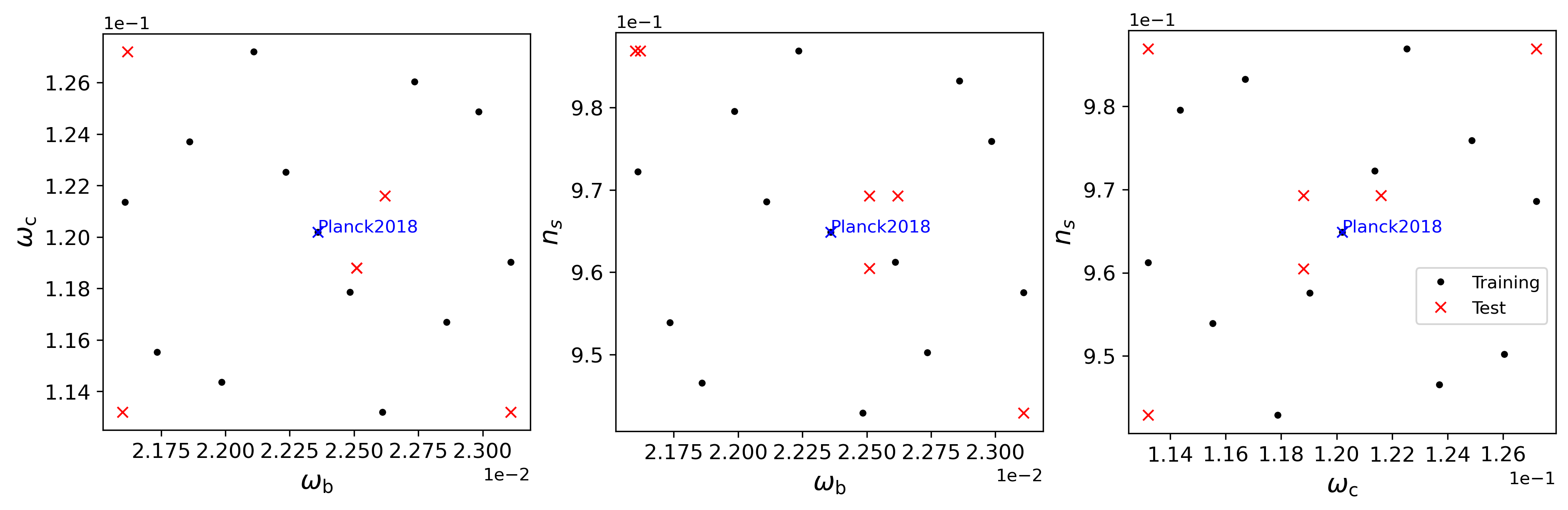
- The cosmological parameter values are listed below for building the emulator, where the model from M000 to M013 are used to train the emulator while the other to test the performance of the emulator.
| Model | wc | wb | ns |
|---|---|---|---|
| M000 | 1.2020e-01 | 2.2360e-02 | 9.6490e-01 |
| M001 | 1.2253e-01 | 2.2235e-02 | 9.8690e-01 |
| M002 | 1.1787e-01 | 2.2485e-02 | 9.4290e-01 |
| M003 | 1.1670e-01 | 2.2860e-02 | 9.8323e-01 |
| M004 | 1.2370e-01 | 2.1860e-02 | 9.4657e-01 |
| M005 | 1.1903e-01 | 2.3110e-02 | 9.5757e-01 |
| M006 | 1.2137e-01 | 2.1610e-02 | 9.7223e-01 |
| M007 | 1.1553e-01 | 2.1735e-02 | 9.5390e-01 |
| M008 | 1.2487e-01 | 2.2985e-02 | 9.7590e-01 |
| M009 | 1.1320e-01 | 2.2610e-02 | 9.6123e-01 |
| M010 | 1.2720e-01 | 2.2110e-02 | 9.6857e-01 |
| M011 | 1.2603e-01 | 2.2735e-02 | 9.5023e-01 |
| M012 | 1.1437e-01 | 2.1985e-02 | 9.7957e-01 |
| M013 | 1.2720e-01 | 2.1619e-02 | 9.8690e-01 |
| M014 | 1.2160e-01 | 2.2620e-02 | 9.6930e-01 |
| M015 | 1.1880e-01 | 2.2510e-02 | 9.6050e-01 |
| M016 | 1.1880e-01 | 2.2510e-02 | 9.6930e-01 |
| M017 | 1.1320e-01 | 2.3110e-02 | 9.4290e-01 |
| M018 | 1.1320e-01 | 2.1600e-02 | 9.8690e-01 |
G2P15-100

(Left panel) the power spectra predicted using both CAMB linear and non-linear models from Planck 2015 cosmology are illustrated. (black solid and dashed lines) It also shows the average of the measured power spectra over 100 non-fixed amplitude simulation realizations with box size 1.89Gpc/h (red cross). (Right panel) The power spectra in the left panel with respect to the CAMB linear spectrum are depicted. The grey circles are from the invidual realizations with different random seed for the initial conditions and the sheded horizontal area in grey indicates the 1% deviation from the linear prediction. Note that since we utilize regular grid distribution for the initial condition, the shot noise caused by the randomness is suppressed in the measured power spectrum at around z > 1, where the shot noise is not subtracted. (ref. Section 3.1. of D. Jeong's dissertation) Please check this page for the details.
G2P18Emu (Fiducial cosmology, M000)

(Left panel) the power spectra predicted using both CAMB linear and non-linear models from Planck 2018 cosmology are illustrated. (black solid and dashed lines) It also shows the average of the measured power spectra over 2 fixed-amplitude but opposite-phases simulation realizations with box size 1.89Gpc/h (red cross). (Right panel) The power spectra in the left panel with respect to the CAMB linear spectrum are depicted. The grey circles are from the invidual realizations with the opposite for the initial conditions and the sheded horizontal area in grey indicates the 1% deviation from the linear prediction. Note that since we utilize regular grid distribution for the initial condition, the shot noise caused by the randomness is suppressed in the measured power spectrum at around z > 1, where the shot noise is not subtracted. Please check this page for the details.
Accuracy test
As an accuracy test of our simulations, a comparison test is performed with the better resolution. Using another simulation with the same number of particles but smaller box size (512Mpc/h), we found below that our simulation shows convergence up to kmax=0.2h/Mpc, which is one of the most conservative values that we usually used in our previous studies employing the simulations. We believe that this kmax should suffice for our study as we are targeting DESI data analysis and according to section 2.4.1 of DESI experiment paper and DESI Y1 paper, these are the scales that DESI is interested in these scales to extract the large-scale structure information.
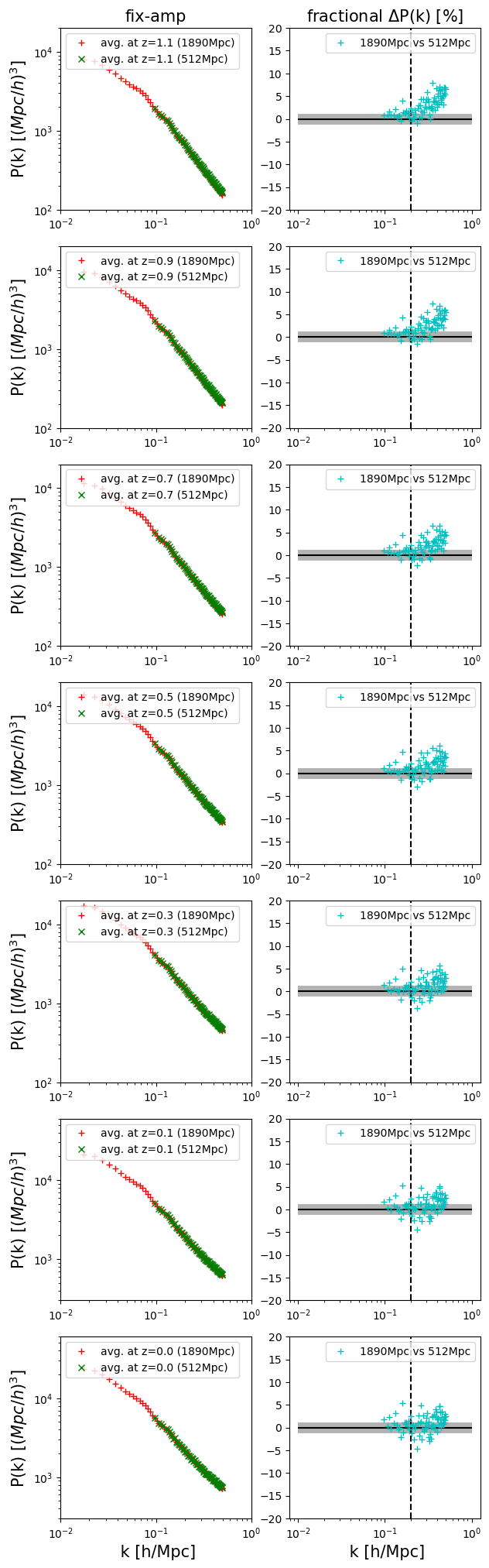
(Left panel) It shows the power spectrum from the initial condition of fixed-amplitude with box size 1.89Gpc/h (red lines) and with box size 512Mpc/h (green lines). Note that those simulations share the same Planck2015 cosmology. (Right panel) the ratios of these simulations with respect to the power spectrum from 512Mpc/h are depicted. Although there are some leftover fluctuations on large scales due to small number of modes and power lack on small scales due to low resolution on the 1890Mpc/h box, we can see that it shows a convergence between two simulations up to k=0.2 h/Mpc, indicating that our larger box simulation aligns with simulations of better resolution at these scales.
Computing resources
- G2P15-100: The work of running simulation was supported by the National Institute of Supercomputing and Network/Korea Institute of Science and Technology Information with supercomputing resources including technical support (KSC-2015-C1-017, KSC-2017-C1-0006). Numerical calculations were performed by using a high performance computing cluster (Polaris) in the Korea Astronomy and Space Science Institute.
- G2P18Emu: The work of running simulation was supported by using a high performance computing cluster (Seondeok) in the Korea Astronomy and Space Science Institute.
List of publication using G2P
| Title | Journal | Authors | |
|---|---|---|---|
| 5 | High precision accelerator for our hybrid model of the redshift space power spectrum | [2311.10823] | M. Icaza-Lizaola, Y. Song, M. Oh, Y. Zheng |
| 4 | Study on the mapping of halo clustering from real space to redshift space | JCAP 06 (2019), 013 | Y. Zheng, Y. Song, M. Oh |
| 3 | Hybrid modeling of redshift space distortions | JCAP 07 (2018), 018 | Y. Song, Y. Zheng, A. Taruya, and M. Oh |
| 2 | Quantification of the multi-streaming effect in redshift space distortion | JCAP 05 (2017), 030 | Y. Zheng, P. Zhang, M. Oh |
| 1 | Study on the mapping of dark matter clustering from real space to redshift space | JCAP 08 (2016), 050 | Y. Zheng and Y. Song |
Data Availability (Not yet ready! Under construction.)
As of now, the downloadable simulations above are only for M000 cosmology. If you are interested in the other ones please contact via the email address below.
Contact Information
minji.wow AT gmail.com
Post-doc at Chosun University